

If you’ve searched Google recently, you’ve probably noticed something: sometimes you get an AI-written answer right at the top of the page, before any of the usual blue links. That’s an AI Overview, and it’s changing how South African customers find businesses like yours, whether or not you’ve ever heard the term for it.
Table of Contents
That term is Generative Engine Optimisation, or GEO. Here’s what it actually means, and what to do about it.
If you want the fuller picture first, why GEO matters for South African businesses specifically, with local examples, start with our intro to GEO. This piece goes one level deeper: the actual mechanics of how AI tools pick what to cite, and a concrete way to check whether it’s working for you.
What is GEO?
GEO is the practice of shaping your website’s content so that AI tools, Google’s AI Overviews, ChatGPT, Perplexity, Gemini, can understand it, trust it, and quote it directly in the answers they give people. Where SEO gets you a ranked link, GEO gets you cited inside the answer itself, sometimes without the customer ever clicking through to a website at all.
How is that different from SEO?
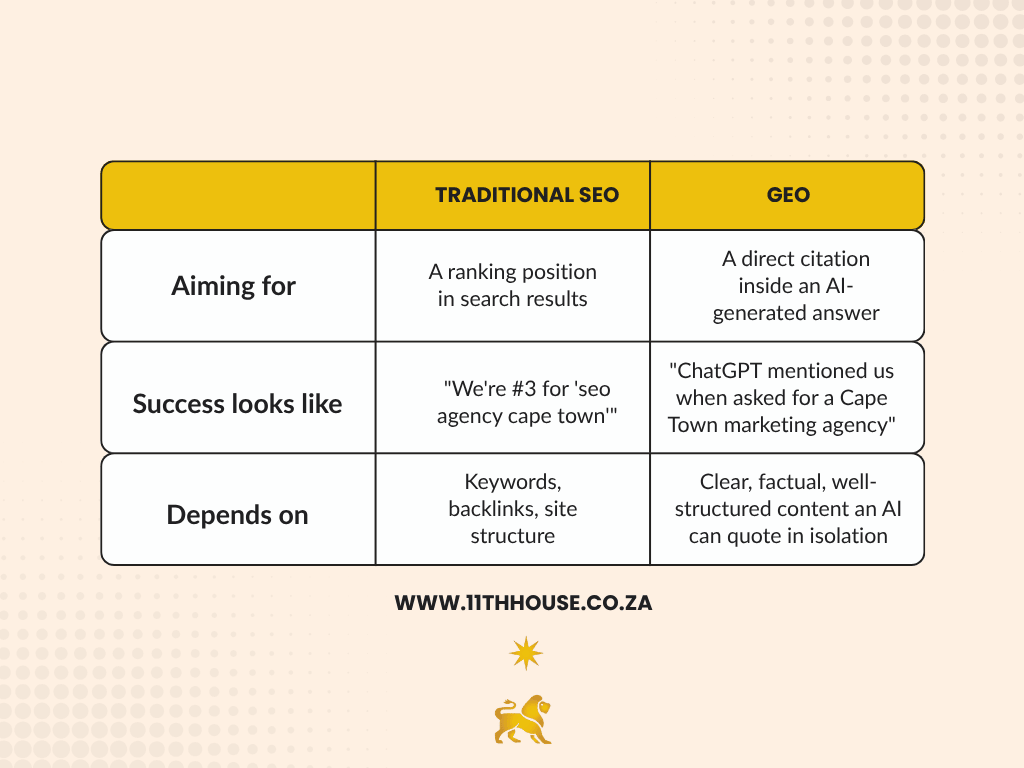
They’re not rivals, GEO builds on the same foundation as good SEO (fast, well-structured, honest content). But ranking well doesn’t automatically mean getting cited. Google’s own systems can skip a page ranking in the top three simply because the answer isn’t written in a way that’s easy to lift out and quote.
Why this matters now, not eventually
This isn’t a future trend to plan for later, it’s already reshaping search today. One widely cited industry study found that 57% of the sources AI Overviews cite come from outside the top 10 organic search results, meaning a business that will never crack page one the traditional way can still get quoted directly in an AI answer, if the content is structured right. For a small or medium business competing against bigger, better-funded competitors on classic rankings, that’s a real opening.
Here’s a realistic (hypothetical) example: a Stellenbosch wine-tasting venue sits on page four for “wine tasting near Cape Town”, a losing position by classic SEO standards. But its FAQ section answers “What’s the best time to visit a Cape wine farm?” in two plain sentences, with a real author name and a page updated last month. When someone asks ChatGPT or Google’s AI Overview that exact question, that page has a real shot at being the one quoted, page-four ranking and all.
Want to know if your own site is one of the ones slipping through this gap? Book a free 15-minute AI-search check and we’ll show you exactly where you stand.
What actually gets a page cited
Based on how Google’s AI Overview selects sources, four things matter most:
- Answer the question in one or two sentences, up front. AI systems favour a clear, stand-alone answer near the top of a page over a long narrative build-up. Lead with the answer, then explain.
- Structure content as clear questions and short answers. A page organised as plain Q&A is easier for an AI system to lift a clean quote from than a wall of paragraphs.
- Show who wrote it and when. A real author name, a clear business identity, and a visible publish/update date all build the kind of trust signal AI systems weigh when choosing what to cite.
- Keep it current. Citations rotate toward freshly updated content, especially on fast-moving topics, an old, untouched page loses ground even if nothing in it is wrong.
How to tell if it’s working: Search Console’s new AI report
Until mid-2026, there was no reliable way to see whether your pages were actually appearing in AI Overviews or ChatGPT-style answers, you were guessing. That changed by 31 August 2026, when Google finished rolling out a dedicated AI performance report inside Search Console to every site worldwide.
It shows impressions, how often your pages appeared inside AI Overviews, Google’s AI Mode, and the AI-powered version of Discover, broken down by page, country, and date. It does not yet show clicks, so you can see a page got picked up, but not whether anyone acted on it. Treat it as an early-warning signal, not a conversion metric.
If a page you’d expect to show up (based on the factors above) isn’t appearing in that report at all, that’s a sign to revisit its structure before worrying about anything else.
Four things you can do this month
- Pick your three most important pages and rewrite the opening paragraph as a direct, one-sentence answer to the question a customer would type.
- Add a short FAQ section to your top service page, three or four real questions customers actually ask, each with a two-sentence answer.
- Put a real name and date on anything you publish. “Written by [Name], [Month Year]” costs nothing and signals a real, accountable business behind the words.
- Refresh (don’t just republish) your best-performing older content, update the numbers, the date, and one section, rather than leaving it untouched.
- Check Search Console’s new AI performance report monthly once it’s available on your property, it’s the only direct signal you currently have for whether any of this is working.
None of this replaces solid SEO fundamentals, it sits on top of them. A page that’s slow, poorly structured, or thin on real information won’t get cited no matter how well-formatted the FAQ is.
The takeaway
AI search isn’t replacing Google search, it’s sitting on top of it, answering more questions before a customer ever scrolls to a results page. Getting cited there isn’t about tricking an algorithm; it’s the same thing that’s always worked in marketing, being clear, being honest, and being genuinely useful, applied to a new kind of reader that happens to be a machine.
Ready to make your site AI-search-ready?
Get a free strategy session, 30 minutes to see exactly where you stand and what to fix first.
Hey, I am Syldrey Mombo, Founder & Director at 11th House Digital Marketing, a Cape Town agency helping South African and African businesses tell the story that gets them found, including how that story shows up in AI Overview search results. Let’s chat, connect with me on LinkedIn.
Do I need to choose between SEO and GEO?
No. GEO builds on solid SEO rather than replacing it, you’re adding citation-focused structure (clear answers, FAQs, real authorship) on top of fundamentals that already need to be right.
How do I know if my site is already showing up in AI search results?
Check Google Search Console’s AI performance report, rolled out to every site worldwide by the end of August 2026. It shows impressions from AI Overviews, AI Mode, and AI-powered Discover, broken down by page.
Does GEO cost extra, or is it part of normal SEO work?
For most small businesses it’s the same work done slightly differently, clearer structure, a real FAQ, visible authorship and dates, not a separate budget line.
How long before I see results?
Citations can appear faster than organic rankings, since there’s no backlink-authority climb involved. But Google also rotates citations toward fresher content, so it rewards businesses that keep updating, not a one-time fix.
Related reading
- Generative Engine Optimisation (GEO): The Next Big Thing for SA Businesses: our original GEO intro, with local examples and benefits
- Social Media Marketing for South African Small Businesses
- Digital Marketing Strategies for Small Businesses in South Africa
- Digital Marketing Strategy services




0 Comments